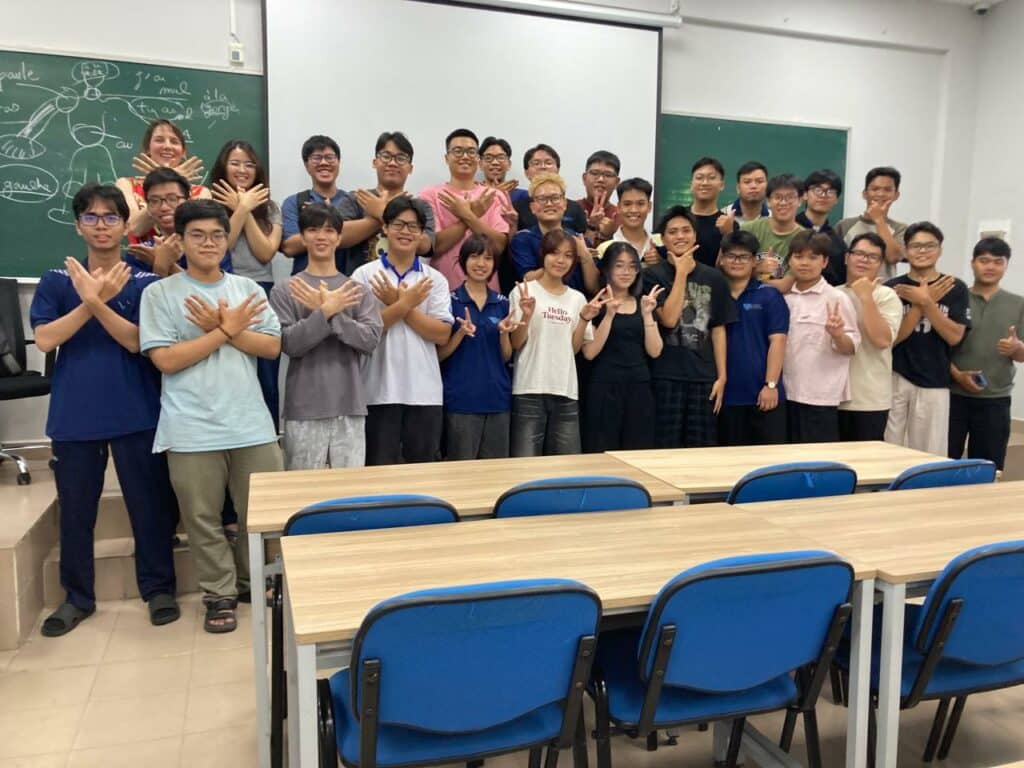
From May 11 to 22, 2026, the PFIEV hosted a French as a Foreign Language (FLE) teaching mission led by Anne Le Bourvellec, an FLE and FOS instructor at the École nationale des ponts et chaussées, for the benefit of two partner institutions in the program: the Ho Chi Minh City Polytechnic Institute and the Hanoi School of Civil Engineering.
This mission was fully in line with one of the PFIEV’s core objectives: to support the learning of French to help engineering students succeed, while fostering the exchange of best practices between French and Vietnamese teachers.
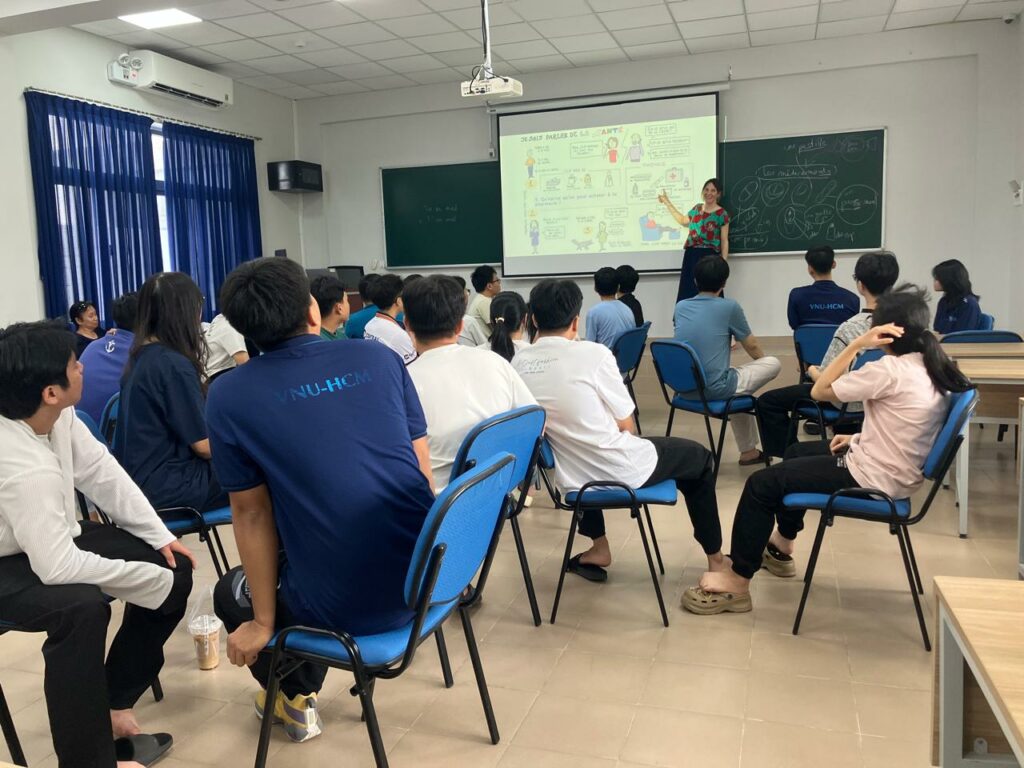
For two weeks, Anne Le Bourvellec led sessions focused on oral expression, self-confidence, and interaction in French, using a performance-based approach inspired by theater workshops. The activities combined physical and vocal warm-ups, phonological exercises, role-playing, prepared speeches, and interpretation exercises, with a clear goal: to make students more comfortable speaking and to promote learning that integrates the body, the voice, emotion, and speech organization.
At the Ho Chi Minh City Polytechnic Institute, the mission involved 16 hours of teaching first-year students. The sessions focused on real-life communication situations related to daily life and academic life, covering topics such as shopping, health, housing, and preparation for the DELF B1 exam.
At the Hanoi School of Civil Engineering, 22h30 of instruction were provided to a more diverse group of students, ranging from first-year to third-year students. The sessions focused in particular on expressive reading, pronunciation, oral improvisation, and creative rewriting, with the aim of developing fluency, listening skills, and a deeper understanding of French through a more lively and hands-on approach.
Beyond the classes themselves, this mission also led to educational exchanges with Vietnamese teachers, particularly through classroom observations and mutual feedback on teaching practices. This aspect is essential: it helps to build local capacity in a sustainable way and fosters a shared reflection on the methods, learning paces, and tools best suited to PFIEV students.
The feedback collected after the sessions has been particularly encouraging. In Ho Chi Minh City, students praised the interactive and engaging approach, which was particularly effective in developing oral communication skills, pronunciation, and self-confidence. In Hanoi, comments highlighted the teacher’s energy, the dynamic classroom atmosphere, the supportive environment, and the motivation generated by the communicative activities.
Local observations also point to a very positive outcome: strong student engagement, a variety of activities, high-quality interaction, relevant teaching materials, and a good alignment between educational objectives and the students’ skill levels. A few areas for improvement were also identified, notably the need to slow down certain group correction sessions slightly and to allow more time for the more reserved students.
This mission serves as a concrete example of the value of staff exchanges between France and Vietnam carried out under the PFIEV: they provide direct benefits to students, support the evolution of teaching practices, and, over the long term, strengthen cooperation between French and Vietnamese institutions.
The PFIEV extends its warmest thanks to Anne Le Bourvellec for her dedication, as well as to the teams at the Ho Chi Minh City Polytechnic Institute and the Hanoi School of Civil Engineering for their work in preparing this mission, their hospitality, and the quality of our discussions.


